
Energy Cost Calculator
How much does it cost to run a space heater, a fridge or a games console? Add appliances with their power in watts and daily hours of use, enter your electricity price per kilowatt-hour, and the calculator shows the energy used and the cost per day, month and year for each — and the total — so you can see where your money goes and what changes save the most.
- Free to use
- No sign-up
- Runs in your browser
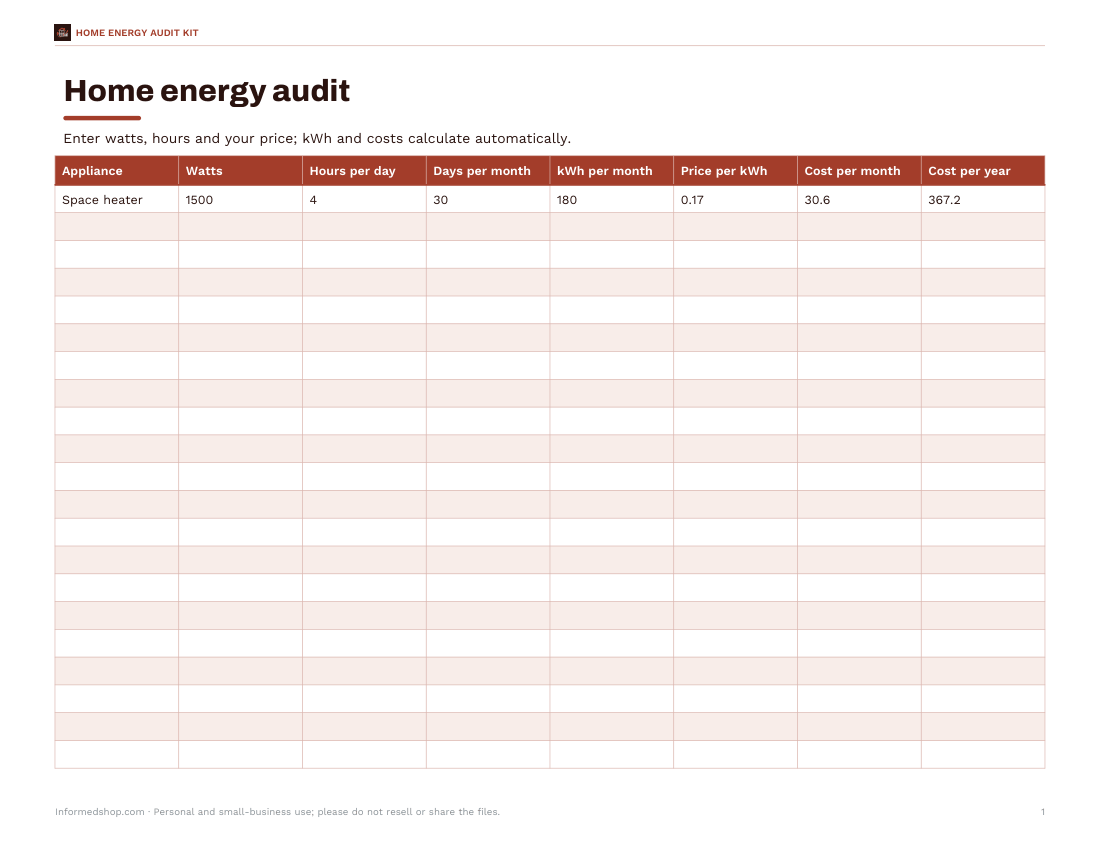
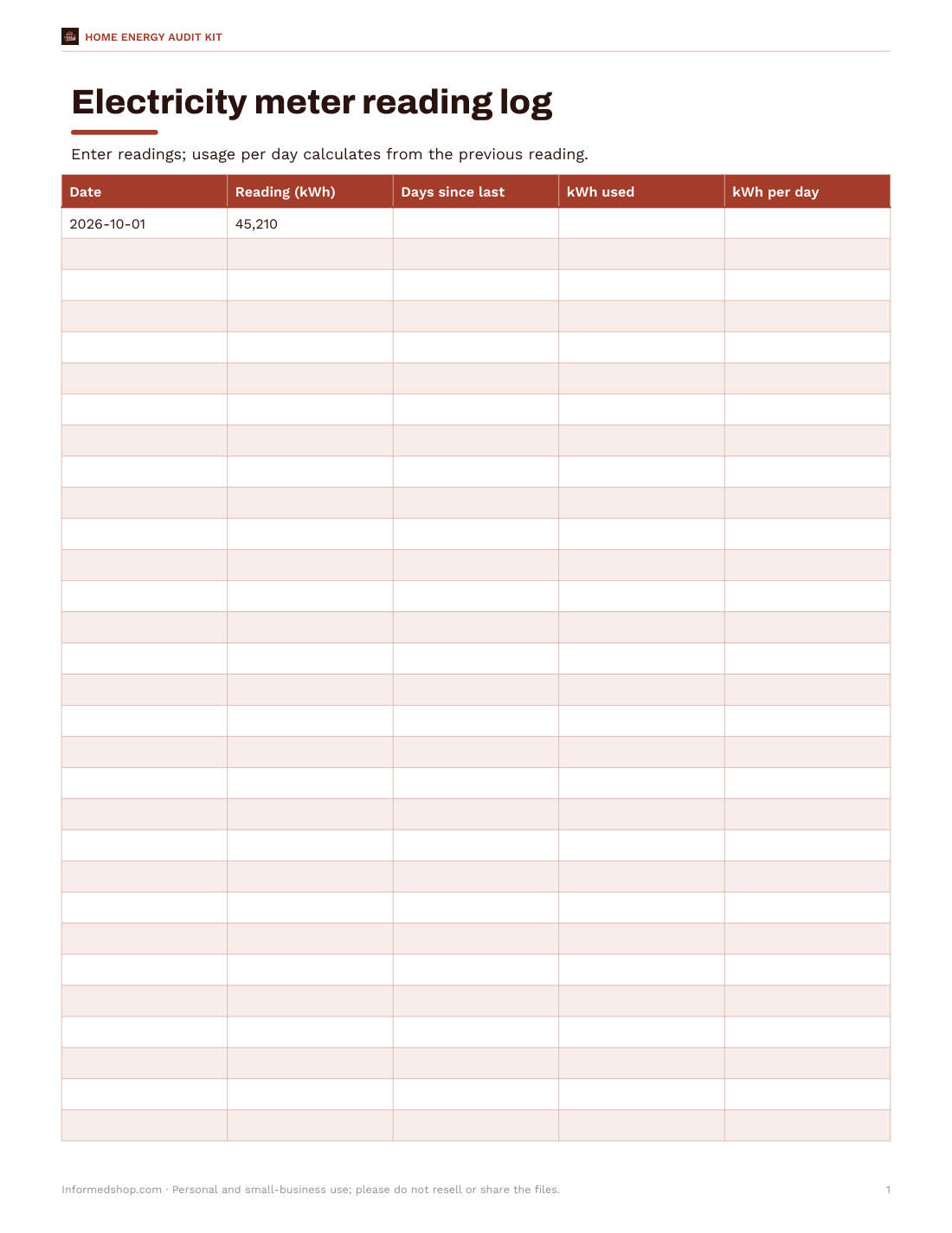
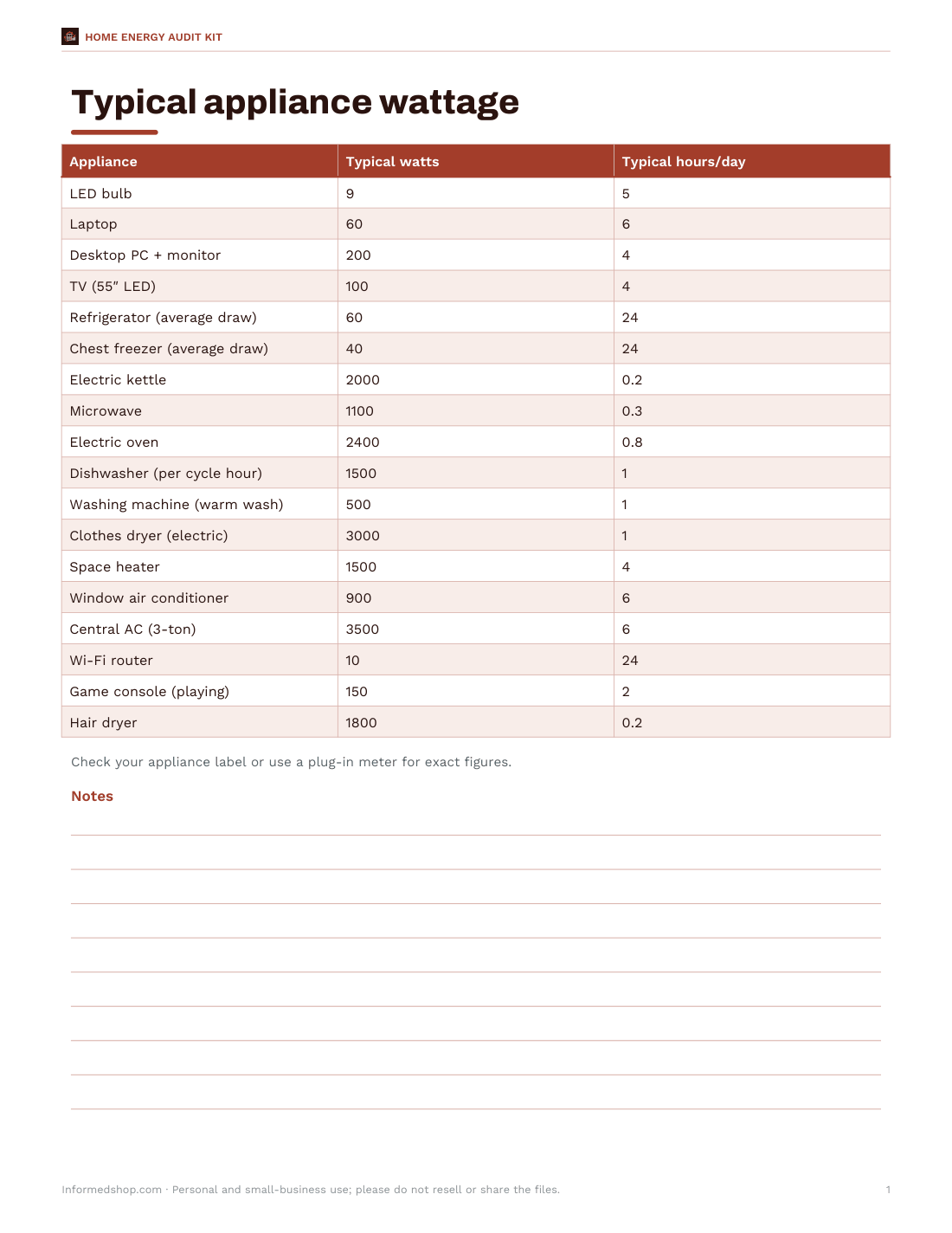
Energy cost calculator
Home Energy Audit Kit
Home energy audit kit: Excel appliance energy and cost workbook, meter reading log with usage per day, appliance wattage reference sheet and an energy-saving checklist.
- Energy audit (XLSX)
- Meter log (XLSX)
- Wattage reference (PDF)
- Saving checklist (PDF, DOCX)
Formats: XLSX, PDF, DOCX. Instant download after payment (link valid 72 hours, up to 5 downloads). AI-assisted: the templates were drafted with AI help and reviewed and laid out before publishing.
$5.00 USD, one-time 4 files · about $1.25 each
- Instant download
- 7-day refund
- Secure checkout by Stripe
7-day money-back guarantee. Full refund within 7 days of purchase, even after you download.
Free sample: Home Energy Audit (PDF, 49 KB)
Full refund within 7 days — see the refund policy and license.
Free printables
Single sheets you can print right now, no sign-up. The full pack adds every sheet in one download plus the editable files.
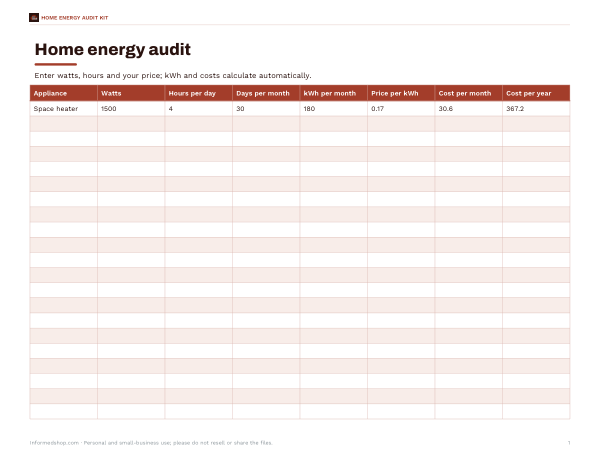 Printable Home Energy Audit Worksheet
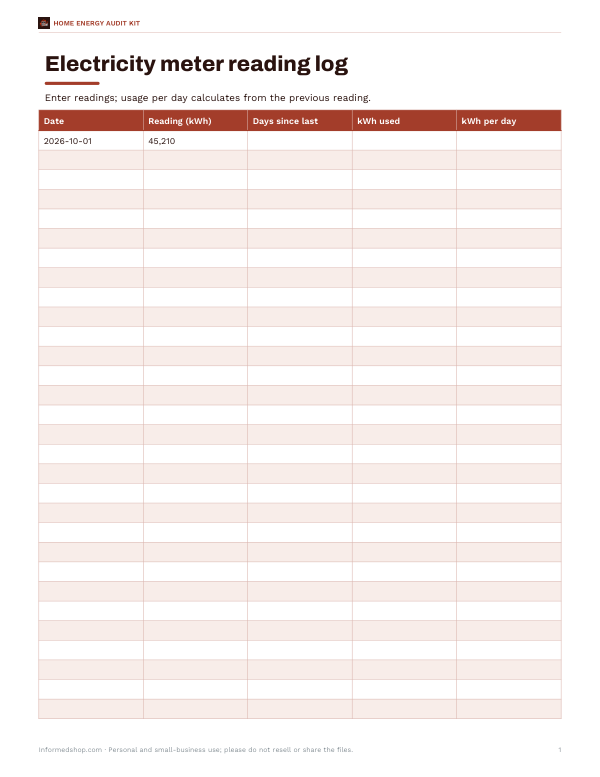 Printable Electricity Meter Log
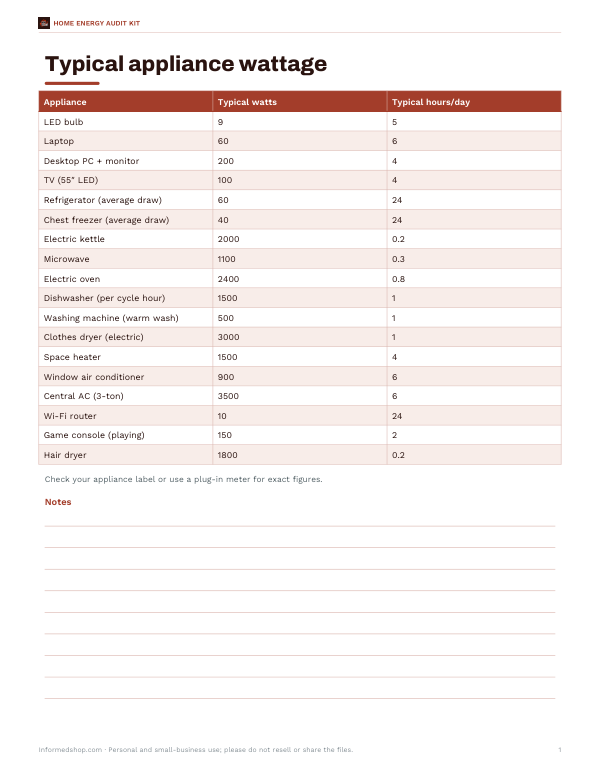 Printable Wattage Reference Chart
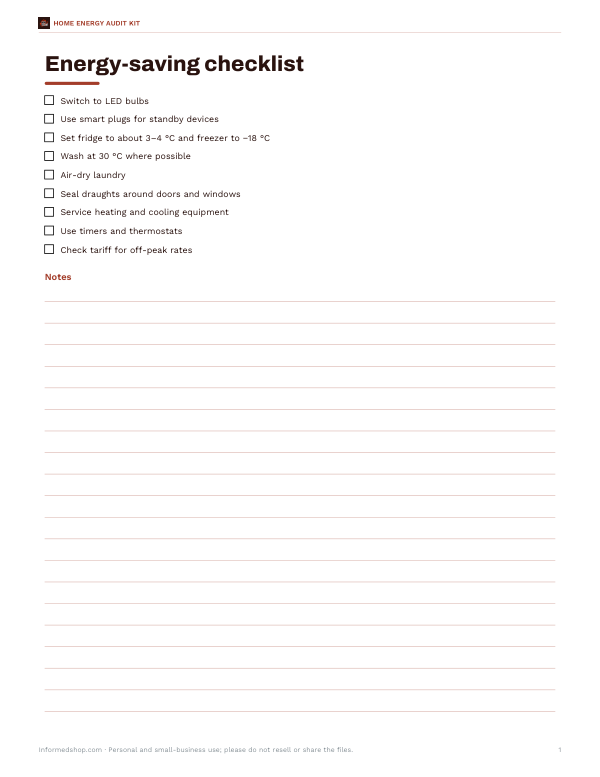 Printable Energy Saving Checklist
How electricity cost is calculated
- Find the power in watts (W) — on the label, in the manual or on a plug-in meter.
- Multiply by hours of use per day to get watt-hours.
- Divide by 1,000 to get kilowatt-hours (kWh) per day.
- Multiply by the number of days, then by your price per kWh.
Formula: cost = watts × hours ÷ 1,000 × price per kWh. A 1,500 W heater used for 4 hours a day uses 6 kWh a day; at $0.17 per kWh that is $1.02 a day, about $31 a month.
Typical appliance power
| Appliance | Typical watts |
|---|---|
| LED bulb | 9 |
| Laptop | 60 |
| Desktop PC + monitor | 200 |
| TV (55″ LED) | 100 |
| Refrigerator (average draw) | 60 |
| Chest freezer (average draw) | 40 |
| Electric kettle | 2000 |
| Microwave | 1100 |
| Electric oven | 2400 |
| Dishwasher (per cycle hour) | 1500 |
| Washing machine (warm wash) | 500 |
| Clothes dryer (electric) | 3000 |
| Space heater | 1500 |
| Window air conditioner | 900 |
| Central AC (3-ton) | 3500 |
| Wi-Fi router | 10 |
| Game console (playing) | 150 |
| Hair dryer | 1800 |
These are typical figures for common models; your appliances may differ. Fridges, freezers and air conditioners cycle on and off, so their average draw is much lower than their rated power. A plug-in energy monitor gives the most accurate numbers.
Finding your price per kWh
Your electricity bill shows the unit rate per kWh, sometimes split into energy and delivery charges; add them together for an all-in rate, but leave out fixed daily or monthly charges, which you pay regardless of use. Rates vary widely between countries, states and suppliers, and time-of-use tariffs charge more at peak times — use the rate that applies when the appliance runs.
How to use the calculator
- Enter your price per kWh and currency symbol.
- List appliances as name | watts | hours per day, optionally with days per month.
- Or pick typical appliances from the dropdown to add them quickly.
- Read each appliance’s daily energy, monthly and yearly cost and its share of the total.
- Try changes — fewer hours, a more efficient model — and see the savings.
Worked example
With electricity at $0.17 per kWh, the sample list costs about $522 a year. The space heater (1,500 W for 4 hours a day) is the biggest item at roughly $367 a year, the fridge about $89, the TV about $25, the laptop about $16 and the kettle about $25. Turning the heater down to 3 hours a day would save about $92 a year.
Standby power
Many devices draw power when “off”: TVs, consoles, chargers, smart speakers and set-top boxes. Individually it is small — often 0.5–5 W — but a household can have dozens of such devices. At $0.17 per kWh, every watt running all year costs about $1.49. Smart plugs, switched power strips and eco settings can cut standby waste.
Ways to cut energy costs
- Heat and cool the person, not the house: heated blankets and fans use far less than space heaters and AC.
- Wash clothes at lower temperatures and air-dry when possible.
- Use LED lighting — typically 75–85% less energy than incandescent bulbs.
- Keep fridge and freezer seals clean and set temperatures correctly.
- Boil only the water you need.
- Shift heavy loads to off-peak hours on time-of-use tariffs.
Heating and cooling
Heating and cooling are usually the largest parts of a home’s energy use, so the thermostat setting matters most. As a rough rule of thumb, each degree Celsius (about two degrees Fahrenheit) of heating set-point reduction saves several percent of heating energy. Heat pumps deliver two to four units of heat for each unit of electricity, so they cost far less to run than resistance heaters like the 1,500 W space heater in the example.
Measuring actual consumption
| Method | What it tells you |
|---|---|
| Plug-in energy monitor | Exact kWh for one plug-in appliance over days or weeks |
| Smart meter / supplier app | Whole-home use by hour or half-hour |
| Meter readings | Daily or weekly household totals |
| Appliance labels | Rated power (maximum), not average use |
| Energy labels (e.g. kWh/year) | Standardised yearly use for comparison |
What the template pack includes
A home energy audit workbook (Excel) with appliance list and costs, a meter reading log, an appliance wattage reference sheet and an energy-saving checklist.
Frequently asked questions
How do I calculate the cost of running an appliance?
Watts × hours ÷ 1,000 × price per kWh.
How much does a 1,500 W heater cost per hour?
1.5 kWh per hour — at $0.17/kWh, about 26 cents an hour.
How many kWh does a fridge use?
Often around 1–2 kWh a day for a modern fridge, depending on size and age.
What is a kWh?
A kilowatt-hour: using 1,000 watts for one hour.
Does standby power matter?
Each watt running all year uses about 8.8 kWh — small per device, but it adds up.
How much does a 100 W bulb cost per year?
Used 5 hours a day at $0.17/kWh, about $31 a year; a 9 W LED costs under $3.
Is it cheaper to run appliances at night?
Only if your tariff has cheaper off-peak rates.
How accurate is the estimate?
It depends on the wattage and hours you enter; a plug-in energy monitor gives exact figures.
Is my data stored?
No, it runs in your browser.